Leadership in the age of AI has become one of the most discussed topics in organizations today. Over the past year, I have had countless conversations about AI.
Some leaders are excited about the possibilities. Others are cautious. Most are somewhere in the middle, trying to understand what AI means for their teams, their organizations, and the future of work.
What I find interesting is that many of the biggest challenges organizations face are not technological at all.
They are leadership challenges.
The Technology Isn’t the Problem
Every major shift in business creates uncertainty. AI is no different.
The questions leaders are asking today are remarkably similar to those asked during previous periods of change. How do we adapt? What does this mean for our people? How do we ensure quality, consistency, and accountability?
While the technology may be new, the leadership challenges are familiar.
People still need direction. Teams still need clarity. Organizations still need leaders who can help navigate ambiguity and uncertainty.
AI Is Revealing Existing Weaknesses
In many organizations, AI has simply exposed issues that were already present.
Consider clarity.
If employees are unsure when AI should be used, when it should not be used, what standards apply, or who owns key decisions, confusion quickly follows. The problem is not the technology itself. The problem is the absence of clear expectations.
Trust is another example.
Some leaders have responded to AI by increasing oversight and control because they are uncertain about how work is being completed. Yet trust has always been a leadership challenge. AI simply shines a brighter light on it.
The same can be said for critical thinking.
If people have become accustomed to waiting for answers rather than exercising judgment, AI will not solve that problem. In some cases, it may amplify it.
Technology can generate information. It cannot replace thoughtful decision-making.
The Skills That Matter Most
One of the biggest misconceptions about AI is that it will reduce the need for leadership.
If anything, the opposite is true.
As information becomes easier to access, leadership becomes less about having the answers and more about helping people ask better questions.
The skills that matter most are the same skills that have always mattered: communication, critical thinking, coaching, accountability, adaptability, and trust.
Leaders who create clarity, encourage healthy debate, and help their teams navigate uncertainty will continue to add tremendous value, regardless of how technology evolves.
What AI Has Really Exposed
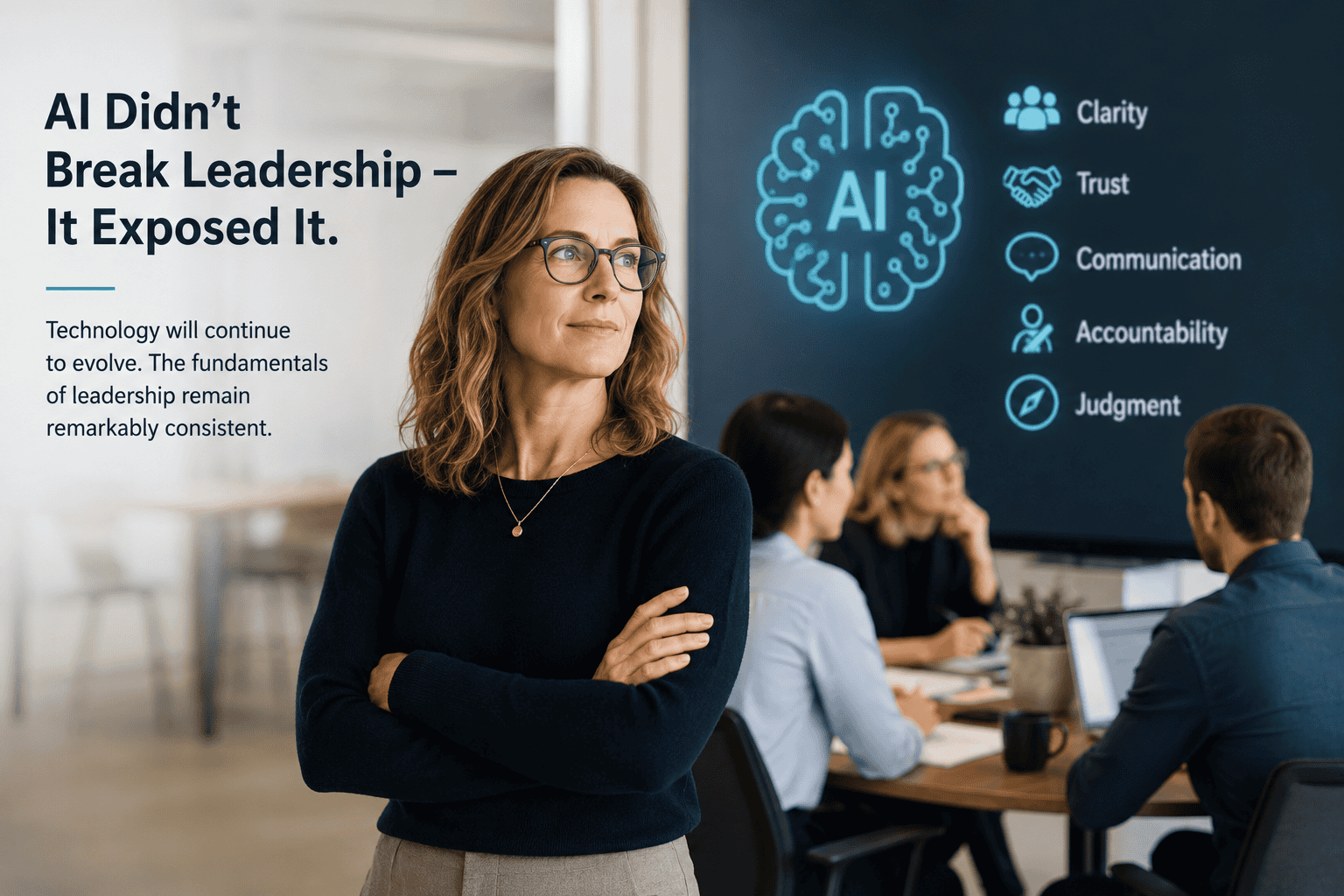
AI did not break leadership.
It exposed where leadership was already struggling.
It highlighted gaps in communication, trust, accountability, and decision-making that may have existed long before AI arrived.
The organizations that benefit most from AI will not necessarily be the first to adopt it. They will be the ones with leaders who can create clarity, build trust, and help people adapt to change.
Technology will continue to evolve.
The fundamentals of leadership remain remarkably consistent.
And that may be the most important lesson AI has taught us so far.

AI may be changing how work gets done, but it has not changed the fundamentals of leadership. If you are looking to strengthen leadership capability, communication, and adaptability within your organization, we’d love to connect and explore how Lead Vantage can help. Connect with us at www.leadvantage.ca.