The World Changed. But Has Our Leadership?
I recently read Stephen M. R. Covey’s Trust & Inspire, and one idea kept nagging at me: our world has changed dramatically, but our leadership style hasn’t necessarily kept up.
Covey identifies five forces that have fundamentally changed the environment in which we lead:
- The nature of the world has changed.
- The nature of work has changed.
- The workplace has changed.
- The workforce has changed.
- The nature of choice has changed.
People simply have more choices today, about where and how they work, who they work for, and how much of themselves they are willing to bring to that work. Expectations have changed too. People want autonomy, purpose, growth, and the opportunity to contribute in meaningful ways.
Yet despite all that change, one leadership model has proven remarkably hard to kill: Command & Control.
You know the model. The leader knows, the leader decides, the leader directs, and everyone else executes. Perhaps with a little “empowerment” sprinkled on top for good measure.
Covey argues that if organizations want to win in the workplace and win in the marketplace, leadership has to evolve too. His alternative is what he calls Trust & Inspire.
The irony is that most of us already know this. Ask leaders whether they want their people to take ownership, use good judgment, challenge thinking, innovate and make decisions without constantly checking in, and you’ll likely get a resounding yes. But then watch what happens when someone makes a decision differently than the leader would have. Suddenly, Command & Control doesn’t seem quite so outdated.
That’s one of the things I liked about this book. Trust & Inspire isn’t simply about being nicer, giving people more freedom or abandoning accountability. It asks us to reconsider what we fundamentally believe about people, because those beliefs ultimately shape how we lead them.
Leadership Style Is a Choice
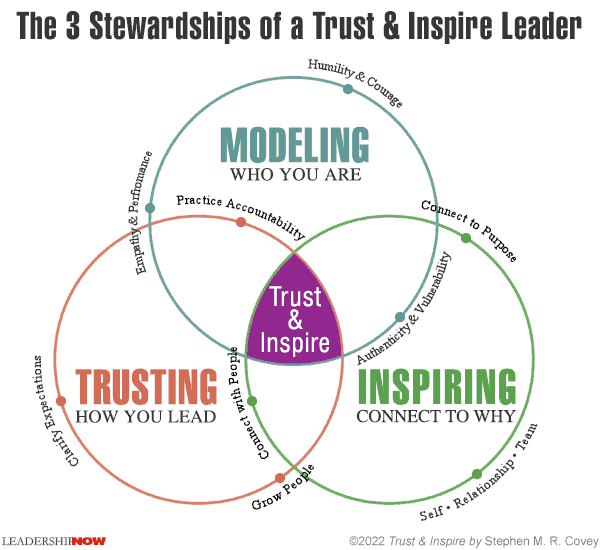
At the heart of Trust & Inspire are what Covey calls the three stewardships: Modelling — Who You Are; Trusting — How You Lead; and Inspiring — Connect to Why.
Underpinning those three stewardships are five beliefs that really capture the shift Covey is asking leaders to make:
- I believe people have greatness in them, and my job is to unleash their potential.
- I believe people are whole people, and my job is to inspire, not merely motivate.
- I believe there is enough for everyone, and my job is to elevate caring above competing.
- I believe leadership is stewardship, and my job is to put service above self-interest.
- I believe enduring influence is created from the inside out, and my job is to go first.
That last one is particularly important because Trust & Inspire leadership doesn’t start with fixing them. It starts with us. Covey describes leadership as an inside-out process that begins with self, moves into our relationships and teams, and ultimately extends to our organizations, stakeholders, markets and society.
In other words, we can’t demand from others what we aren’t prepared to model ourselves.
Modelling: Who You Are
One of my favourite lines in the book is, “People close their ears to advice and open their eyes to example.”
We can talk about trust, accountability, vulnerability and respect all day long, but people are paying far more attention to what we actually do. How do we react when someone disagrees with us? What happens when we make a mistake? Do we take accountability when things go wrong? Do we behave the same way under pressure as we do when everything is going well?
Covey describes modelling as a combination of qualities that we don’t always put together: humility and courage, authenticity and vulnerability, empathy and performance. I particularly liked that last combination because it pushes back on the idea that Trust & Inspire is somehow “soft” leadership. It isn’t about lowering expectations or avoiding difficult conversations. We can care deeply about people and expect a lot from them.
Covey also describes vulnerability as the gateway to authenticity. We don’t build credibility by pretending to have all the answers. Sometimes credibility comes from being willing to say, I got that wrong. I don’t know. What do you think?
For some leaders, those may be the three most terrifying sentences in the English language.
Trusting: How You Lead
This may be where Trust & Inspire becomes most difficult in practice, because trusting people means extending trust, not simply talking about how important trust is.
Covey isn’t advocating blind trust. He calls it smart trust: starting with a high propensity to trust while still considering the situation, the risk and the people involved. Trust also doesn’t mean handing something over and saying, ” Good luck; let me know how it goes”. Clear expectations and accountability still matter.
In fact, Covey outlines five elements of what he calls a stewardship agreement: desired results, guidelines, resources, accountability and consequences. The difference is that, rather than controlling every step of how someone gets there, the leader creates clarity around the outcome and then lets the person take ownership.
And that is where the real payoff comes in. When leaders continually step in, solve the problem, make the decision or take the work back, people never have the opportunity to develop the very capabilities we say we want them to have. When we extend trust appropriately, people have an opportunity to rise to the occasion, learn, develop new capabilities and, importantly, reciprocate that trust.
Covey describes our role as leaders as a cycle: see the potential, communicate what we see, develop what we see and then unleash it.
That’s a very different job description from being the person with all the answers.
Inspiring: Connect to Why
The third stewardship is about inspiration, connecting people to purpose. Covey argues that this connection has to begin with us. If we aren’t connected to why the work matters, it’s going to be awfully difficult to inspire anyone else.
From there, inspiration moves into our relationships and ultimately our teams. It means helping people understand not simply what they are doing, but why it matters and how their contribution connects to something bigger.
There is a significant difference between getting someone to do something because they have to and creating an environment where they genuinely want to contribute. One may produce compliance; the other can create commitment.
And I think that distinction matters. We can manage people into doing what is required of them. Trust & Inspire asks whether we can create the conditions where they choose to bring more of themselves to the work.
If This Makes So Much Sense, Why Aren’t We All Doing It?
This was probably one of my favourite parts of the book because Covey tackles the objections that many leaders are already thinking: This won’t work here. What if I lose control? What if I trust someone and it doesn’t work? What if I’ve been burned before? What if they fail? What if I don’t get credit? And what if, frankly, I really am the smartest person in the room?
Covey groups these into five common barriers to becoming a Trust & Inspire leader: believing it won’t work in our environment, fear, not knowing how to let go, believing we’re the smartest person in the room, and, perhaps most limiting of all, “this is just who I am.“
His responses challenge some deeply ingrained leadership habits.
If we think this won’t work here, the answer isn’t to wait for everyone else to change. We model it first and become part of the solution. If fear is holding us back, Covey encourages us to practise smart trust, balancing the potential risk against the potential return. If we’ve been burned before, he reminds us not to let our experience with one person determine what we believe about everyone else.
If letting go is the problem, we need to increase our tolerance for failure while staying focused on learning and course correction. If we believe we’re the smartest person in the room, the challenge is to become a multiplier, someone who draws out and uses the strengths and intelligence of the people around them.
And then there’s the final barrier: This is who I am. I can’t change.
Covey’s response to that one may be my favourite mindset shift in the book: “I’m the programmer, not the program.”
Maybe It’s Time to Retire the Cape
One idea I kept coming back to while reading Trust & Inspire is that this kind of leadership requires many successful leaders to give up something they’ve been rewarded for throughout their careers: being the hero.
Having the answer, solving the problem, catching the mistake, making the decision and saving the day can feel incredibly useful. Sometimes it even feels like great leadership. And, of course, there are times when a leader does need to step in.
But if we are always the hero, what role have we left for everyone else?
Trust & Inspire asks us to do something harder. It asks us to see greatness in people before they’ve necessarily demonstrated all of it, give them room to step up, clarify expectations, hold them accountable, let them stumble occasionally, coach them through it, and then get out of the way enough for them to surprise us.
Perhaps that is why Command & Control has been so difficult to leave behind. It can feel safer, faster and more efficient, particularly when we’re under pressure. Trusting someone else can feel slower and riskier in the moment.
But Covey’s bigger question is about what we are trying to build for the long term.
The world of work has changed. The people we lead have changed. Their expectations and choices have changed.
Maybe the question isn’t whether our leadership style needs to change with them. Maybe the more interesting question is: what are we still holding onto, and why?

Sofia and Linda_Lead Vantage
Ready to retire the cape? At Lead Vantage, we work with leaders and teams to build the trust, ownership, and accountability that let people step up, so leaders don’t always have to step in. Contact us at www.leadvantage.ca to learn more!
Linda Lucas brings 25+ years of experience in finance, operations, and strategy to the table. Her expertise lies in coaching, mentoring, and facilitating programs that empower and increase collaboration.